The Village Worthy
On people pleasing, perfectionism, and the danger of a spotless reputation.
The Passages
Hover over (or tap on mobile) Chinese characters for definitions. Use the 拼 button to toggle pinyin.
17.13
13.24
子曰:「未可也。」
「鄉人皆惡之,何如?」
子曰:「未可也。不如鄉人之善者好之,其不善者惡之。」
The Master replied, "That won't do."
"And what if someone is loathed by everyone?"
The Master replied, "That also won't do. Better that the good people of their village like them, and the bad dislike them."
Informal interpretation:
"So having a spotless reputation doesn't mean you're actually one of the good ones?" I replied.
"Yup."
I thought for a second. "Alright, well if you can't trust people's opinions, what about being a contrarian? I mean, what about the guy everyone hates?"
"That's a problem too."
"Ok I give up," I sighed. "Then how can you tell who's got it right?"
So he spelled it out for me. "First be clear on what it means to do good. If the people you see doing good like you, and the people you see doing bad dislike you, then you're onto something."
This episode tackles the concept of the village worthy (鄉愿) — the person who does everything they can to be liked by everyone. Through passages 17.13 and 13.24, we explore why Confucius considered a spotless reputation not just unimpressive, but actively harmful to morality itself.
Philosophical Discussion
The Village Worthy (鄉愿)
The 鄉愿, or Village Worthy, is someone who does everything they can to be liked by everyone. They're a people pleaser and a perfectionist — not satisfied with winning the praise of just some people, it has to be everyone. 12th century commentator 呂伯恭 described them as someone who wants 慾盡合天下人 — "to the greatest degree possible, to accord with all people under heaven." They follow prevailing trends to fit in with commoners and act loyal and pure to seek the approval of gentlemen.
The problem? Ask ten different people about the Village Worthy and you'll get ten different answers — each one a reflection of the asker more than the Village Worthy themselves. Nobody actually knows who this person is, because there's nothing real behind the mask.
The Thief of Moral Charisma
Confucius calls the Village Worthy the "thief" of 德, or moral charisma. As discussed in Episode 5, 德 is a practically gravitational force — when someone has it, their goodness attracts and rectifies others. The Village Worthy has a similar attractive power, but it's more like a black hole. Rather than real substance pulling people close, it's a void with no true morality behind it. The danger is that the Village Worthy fools people into thinking they know what morality looks like, diluting the real thing.
Be Liked by the Right People
In 13.24, 子貢 asks whether universal approval is a sign of goodness. Confucius says no — and that universal hatred is just as bad. What's better is being liked by the good and disliked by the bad. This is classic 中庸 thinking: never go to extremes. Aim for the right people to approve of you, and be comfortable with the fact that some will dislike you.
The passage uses 善者 and 不善者 for "good" and "bad" people, but 善 in Confucius's time meant something closer to "adept" or "skilled" — specifically, skilled at the virtuous behaviors Confucius valued, like extending love from family to humanity, and balancing directness with propriety. So it's not a tautology: it's saying that those who've put in the work to develop their character should recognize the same effort in you.
Context and Connections
Related Passages
- 1.3 — Clever words and insinuating appearance
Language Notes
鄉 (xiāng)
Village or countryside, as in modern Chinese 鄉村. We see two compounds here: 鄉愿 (the Village Worthy) and 鄉人 (village people). It's a bit metaphorical in these passages — it really means a community, much like we say someone is "in town" when they're in the area.
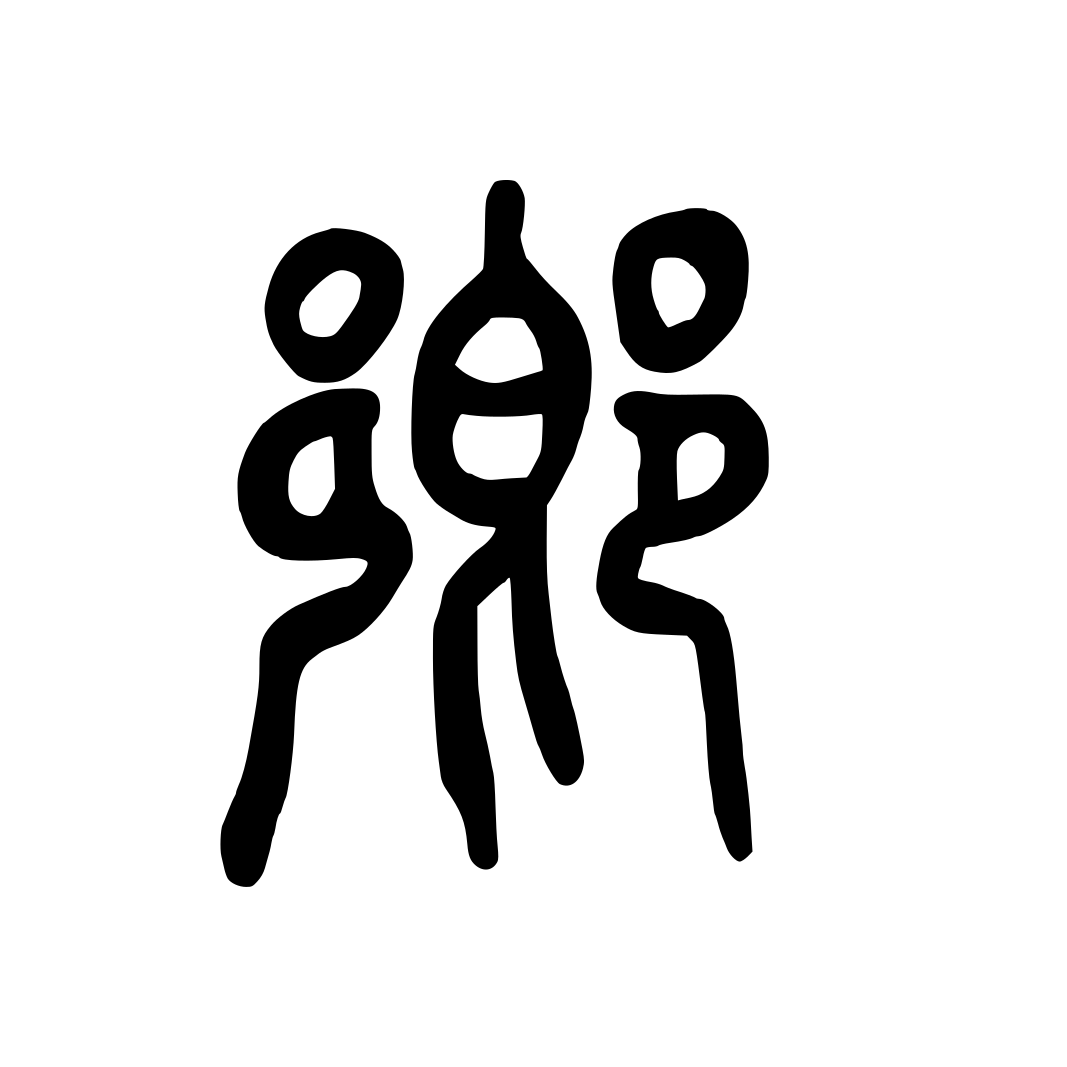
The character was originally a pictograph of two people kneeling and sharing a meal. The idea was that people who eat together share a community, and by extension it came to mean the area where one lived. According to the Outlier Dictionary, "all components of the modern form are empty" — no element of the modern character references its actual meaning.
愿 (yuàn)
Refers to someone who is "cautious and honest." But since we're dealing with appearances only, the appellation shouldn't be read as an honest assessment of their character. It's almost like calling someone a try-hard — yes, their actions show they're trying hard, but it's derogatory. They're trying hard for all the wrong reasons.
賊 (zéi)
Thief. This character is still in use with the same meaning today. In Japanese, the most common word for pirate is 海賊 (kaizoku). In Chinese, 海盜 is more commonly heard for pirate.
曰 (yuē)
A pictograph of an open mouth with the tongue visible. It simply means "to speak." 子曰 means "Confucius said." 子貢問曰 means "Zigong spoke, asking."
何如 (hé rú)
A way of soliciting an opinion. 何 is a question word, still used in modern Chinese though not very colloquially, and 如 is the concept of comparison. The phrase is a terse Classical Chinese utterance asking "what about" or "what do you think."
We also see 不如 in the last sentence — the same 如, now paired with the negative 不, making a statement: "it compares unfavorably" or "it's not as good as" something else.
未可 (wèi kě)
未 means "not yet." Modern Chinese examples: 未來 (future — literally "not yet come"), 未成年人 (a minor — not yet mature), 未知 (not yet known). Combined with 可 (acceptability), it becomes "not yet acceptable." Rendered as "That won't do" to keep things colloquial, with the implication that you can do better.
皆 (jiē)
One of the most common Classical Chinese terms meaning "all." This isn't the kind of "all" that means always or generally — it refers to all things in a group, like all the people in the village.
好 (hào) and 惡 (wù)
Both can have multiple meanings. 好 does not mean "good" here — it means to like, enjoy, or admire. 惡 can mean evil or to detest. Since you can't "evil" a person, it means to detest, which is the natural counterpart to admire.
善 (shàn)
In this context, 善者 is a virtuous or well-behaved person. As discussed above, the original meaning was closer to "adept" or "skilled."
也 (yě)
A grammatical particle indicating the speaker is making a firm statement — not asking a question, not making a suggestion. It frequently ends sentences in Classical Chinese.
之 (zhī)
Mostly functions like 的 in modern Chinese, indicating possession or association. 德之賊 is the thief OF virtue. 皆好之 means they all approve OF the person in question. 鄉人之善者好之 means the virtuous people OF the village approve OF this person.
其 (qí)
A grammatical particle with a variety of possible meanings in 13.24. Should we translate it as "and," give it a contrastive "but," or read it as possessive? The major translations don't particularly affect the meaning of the passage. The contrast between the phrases is enough to draw attention to it.